journal image

Study Examines Links Between Neighborhood Health Factors and TBI Recovery

Duke AI Health Director of Data Science Ben Goldstein, PhD, is among the authors of a new retrospective cohort study that examines relationships between patient outcomes during recovery from traumatic brain injuries and a set of social determinants of health, assessed at the level of the neighborhood environment. The article, titled “Association of neighborhood disadvantage with clinical and healthcare utilization outcomes following traumatic brain injury,” is available online ahead of print from the Journal of Clinical Neuroscience.

Study Examines Links Between Neighborhood Health Factors and TBI Recovery Read More »

EMNLP image

Research Spotlight: EMNLP Findings on How Users Seek Health Information from AI


People are increasingly seeking healthcare information from large language models (LLMs) via interactive chatbots, yet the nature and inherent risks of these conversations remain largely unexplored. Recent research led by Monica Agrawal, PhD, a Duke AI Health faculty affiliate, releases HealthChat-11K, a curated dataset of 11K real-world chatbot conversations in which users seek healthcare information. This dataset can be used to analyze user interactions, including dangerous interactions with the potential to induce sycophancy in LLMs. The paper, titled “‘What’s Up, Doc?’: Analyzing How Users Seek Health Information In Large-Scale Conversational AI Datasets”, was presented in November as a Findings paper at the Conference on Empirical Methods in Natural Language Processing (EMNLP).

READ MORE

Research Spotlight: EMNLP Findings on How Users Seek Health Information from AI Read More »

Publication image

Duke Authors Explore Approaches for Better Diagnostic Modeling in Autism

In a new research article titled “Using mixture cure models to address algorithmic bias in diagnostic timing: autism as a test case,” group of Duke authors, including AI Health Director of Data Science Ben Goldstein, PhD, and Data Science Fellowship Director Matthew Engelhard, PhD, examine algorithmic approaches for models used to predict autism diagnosis. The simulation study, which is published in the journal JAMIA Open, suggests that mixture cure models show promise in improving predictive modeling in autism and potentially other conditions.

READ HERE

Duke Authors Explore Approaches for Better Diagnostic Modeling in Autism Read More »

ORBIT image

ORBIT Winter School in Real-World Analytics

Join the ORBIT (Observational Research Building Interdisciplinary Therapeutic Advances) Interdisciplinary Hub for a three-day Winter School in Real-World Data Analytics, January 28–30, 2026. This virtual event is open to anyone interested in real-world data analytics, regardless of affiliation with Duke University. Over three days, attendees will explore the promises and pitfalls of artificial intelligence in clinical research using real-world data, review foundational methods of causal inference and econometrics, and examine the interplay between real-world data and clinical trial design, conduct, and analysis. Speakers include AI Health Faculty Council’s Ricardo Henao and Fan Li, AI Health Faculty Affiliates Monica Agrawal and Chuan Hong, and the following faculty and experts: David CarlsonFeng GaoJay LuskBrian Mac GroryRyan McDevittEmily O’BrienDylan ThibaultLaine ThomasChengxin Yang, and Anqi Zhao.

LEARN MORE

ORBIT Winter School in Real-World Analytics Read More »

Invented

Invented at Duke Returns for Fall 2025 Showcase

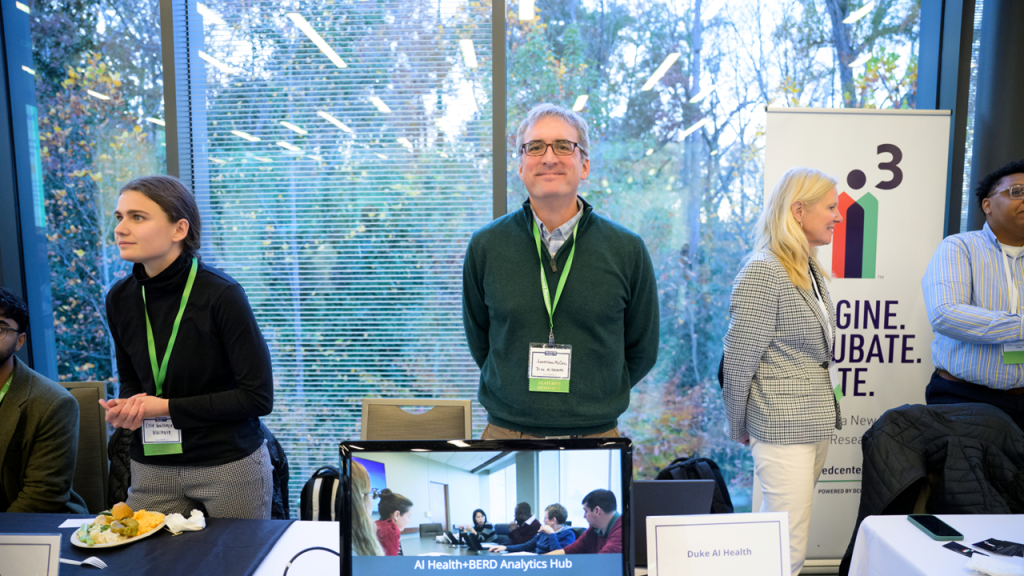
Inventions and emerging technologies developed at Duke were on display at the seventh annual Invented at Duke celebration, held at Duke’s Penn Pavilion on November 11. The showcase, which is hosted and sponsored by Duke’s Office of Translation and Commercialization, puts a spotlight on the university’s innovation and entrepreneurship ecosystem and offers networking opportunities for numerous featured resources – Duke AI Health among them!

READ MORE

Invented at Duke Returns for Fall 2025 Showcase Read More »

Ricardo Matt pub

Machine Learning Models for Predicting Retinopathy of Prematurity

A research article published in the journal Neonatology and featuring a group of authors from Duke’s Department of Pediatrics and AI Health’s Matthew Engelhard, PhD, and Ricardo Henao, PhD, explores the use of machine learning models to improve risk predictions for retinopathy of prematurity. The article, titled “Machine Learning Risk Prediction for Treated Retinopathy of Prematurity in Infants,” appears online ahead of print.

READ HERE

Machine Learning Models for Predicting Retinopathy of Prematurity Read More »

Summit impact

Looking Back on the Duke Summit on AI for Health Innovation

Following this October’s Duke Summit on AI for Health Innovation, co-hosted by Duke AI Health, Duke’s Center for Computational and Digital Health Innovation, and the Duke Clinical Research Institute, Duke AI Health Research Scientist Whitney Welsh, PhD, has compiled an impact report distilling some key information from the two-day convening, including breakdowns of conference attendees, insights from attendees, and complete lists of speakers, panelists, partners, sponsors, and discussion group representatives.

READ MORE

Looking Back on the Duke Summit on AI for Health Innovation Read More »

graphic Proposal Studios Fall 2025

2025 Medical Imaging & AI Proposal Studios Empower New Investigators

The 2025 Medical Imaging & AI Proposal Studios selected three outstanding proposal concepts from new investigators for intensive scientific feedback and design support. During November studio sessions, investigators collaborated with some of Duke’s leading data-science experts to strengthen their proposals for upcoming high-impact funding opportunities. This effort reflects our broader commitment to accelerating innovative research at Duke through expert mentorship, interdisciplinary collaboration, and strategic proposal development.

LEARN MORE

2025 Medical Imaging & AI Proposal Studios Empower New Investigators Read More »

CACHE logo

Duke CACHE Announces 2026 Request for Applications

The Collaborative to Advance Clinical Health Equity (CACHE) at Duke Health is soliciting applications for innovative projects that leverage CACHE’s infrastructure and capabilities to identify, address, and eliminate disparities in healthcare. This RFA seeks interdisciplinary projects that utilize data science, comparative effectiveness research, predictive modeling, quality improvement, implementation science, social epidemiology, and community engagement to identify and mitigate healthcare disparities. Selected projects will receive substantial analytics, informatics, community engagement, quality improvement framework didactic training, QI engineering support, and mentorship from the CACHE team. In addition, CACHE will work with health system leaders to provide project management, informatics, and statistical support.

LEARN MORE

Duke CACHE Announces 2026 Request for Applications Read More »

CACHE awardees

Supporting Interdisciplinary Collaboration to Improve Health Outcomes

Earlier this spring, Duke’s Collaborative to Advance Health Equity (CACHE) Initiative awarded 1-year grants for three proposals to improve care in the Duke Health system. Focused on addressing areas where current approaches to care and support could be improved, the three projects include identification and treatment of chronic kidney disease (CKD), transitions of care for patients with opioid use disorder (OUD), and improving screening for lung cancer, all of which pose substantial challenges among patients served by Duke Health. “We wanted to focus on work that brings together elements of care that have been shown to be effective but haven’t yet been widely integrated into clinical workflows or scaled,” notes CACHE Director Michael Pignone, MD, MPH.

READ MORE

Supporting Interdisciplinary Collaboration to Improve Health Outcomes Read More »