Ricardo newsletter

Duke AI Health Co-Authors Article Proposing More Efficient Approach for Video-based Deep Learning

In a research article published this month in the journal BMC Medical Imaging, Duke AI Health Faculty Council Member Ricardo Henao joins first author Conor Artman to describe a new approach for using deep learning models to detect clinically significant data in echocardiograms. Unlike commonly used but data-intensive segmentation models, the authors propose a “Scaled Gumbel Softmax” deep learning model that offers improvements over existing models while requiring fewer resources.

READ HERE

Duke AI Health Co-Authors Article Proposing More Efficient Approach for Video-based Deep Learning Read More »

Pencina & Chuan pub

Developing an Evaluation Framework for Clinical AI

In an article by Mariah Drexler and Elaine Xiao that originally appeared in the Duke Chronicle, former AI Health Director Michael Pencina, PhD, and AI Health Faculty Affiliate Chuan Hong, PhD, are interviewed about their work in creating SCRIBE, a framework for evaluating AI applications that generate real-time notes during patient encounters in a hospital or other clinical setting.

READ MORE

Developing an Evaluation Framework for Clinical AI Read More »

Duke landscape image

Announcing Duke AI Health Industry Studios

We are excited to announce the launch of the Duke AI Health Industry Studios program. Powered by AI experts in Duke’s Department of Biostatistics & Bioinformatics, we offer half- or full-day design workshops tailored to an organization’s strategy, problem-solving, and solutions development. Our Duke faculty conduct research on the frontiers of health AI methods and real-world applications and can help partners develop solutions to their toughest challenges, no matter where they are in AI implementation, from data collection and management to model development, or from measuring model performance to ongoing monitoring.

LEARN MORE

Announcing Duke AI Health Industry Studios Read More »

Poster Showcase Invitation

Save the Date: Health Data Science Poster Showcase Takes Place December 12, 2025

Mark your calendars! Duke AI Health, in partnership with Duke Health and the Pratt School of Engineering, will be hosting the Health Data Science Poster Showcase on Friday, December 12, from 11:30 AM to 1:30 PM at Duke’s Fitzpatrick Center for Interdisciplinary Engineering, Medicine and Applied Sciences (FCIEMAS) Atrium, Ground Level. No registration is needed for this event, which is free and open to the public. We encourage everyone to come by and catch a glimpse of some of the innovative ideas in health data science percolating at Duke!

Save the Date: Health Data Science Poster Showcase Takes Place December 12, 2025 Read More »

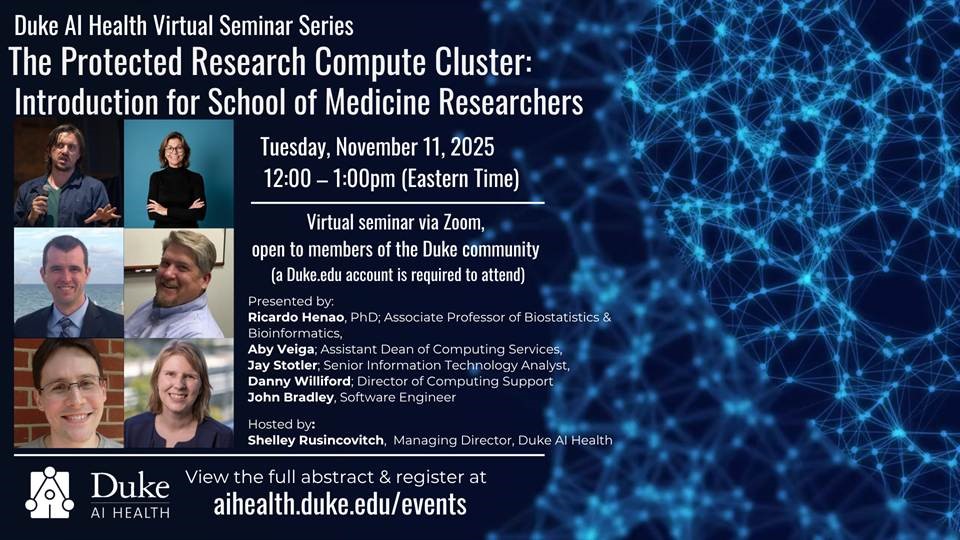
Electronic poster and graphic for 2025 Duke AI Health Virtual Seminar Series - The Protected Research Compute Cluster: Introduction for School of Medicine Researchers.

AI Health Virtual Seminar Series: The Protected Research Compute Cluster: Introduction for School of Medicine Researchers

Join Duke AI Health for a virtual seminar, “The Protected Research Compute Cluster: Introduction for School of Medicine Researchers,” on Tuesday, November 11, 2025, from 12–1 p.m. ET. This session will introduce the Protected Research Compute Cluster (PRCC)—a new, secure high-performance computing environment that will replace PACE with expanded capacity, improved reliability, and scalable technology for sensitive data research. Presenters include Ricardo Henao, PhD, Aby Veiga, Jay Stotler, Danny Williford and John Bradley, and the session will be hosted by Shelley Rusincovitch, MMCi.

REGISTER

AI Health Virtual Seminar Series: The Protected Research Compute Cluster: Introduction for School of Medicine Researchers Read More »

Summit collage

Second Annual Duke Summit on AI for Health Innovation Explores How AI Is Shaping the Future of Healthcare

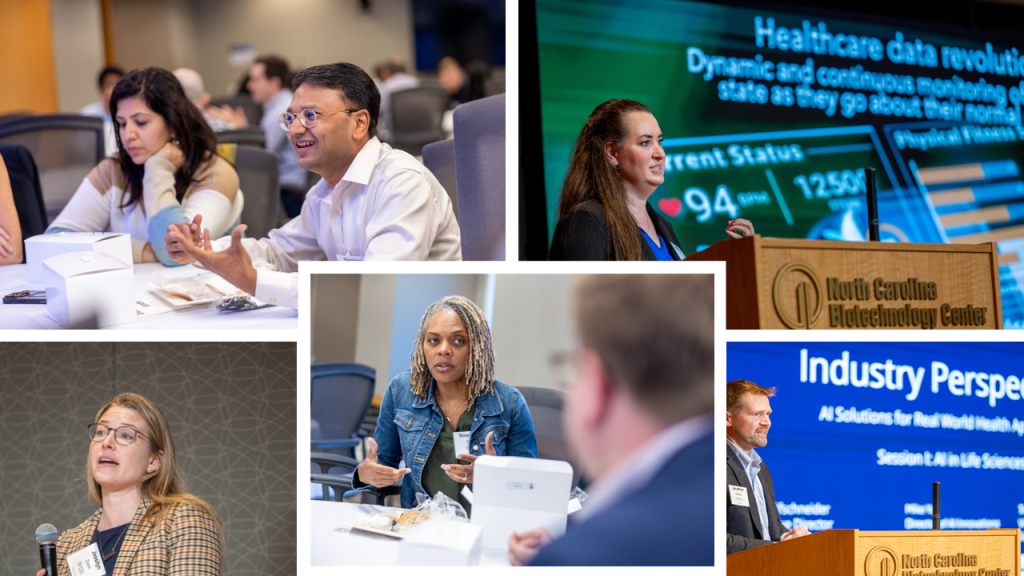
This past October, Duke AI Health, in partnership with the Center for Computational and Digital Health Innovation at Duke University and the Duke Clinical Research Institute (DCRI) hosted the 2nd annual Duke Summit on AI for Health Innovation at the North Carolina Biotechnology Center in Research Triangle Park. The conference, which took place October 8-9, brought together experts representing a wide range of fields including healthcare, engineering, computer science, and the biomedical sciences to explore how AI can drive health innovation. Through a series of presentations, lightning talks, panel discussions, and structured “breakout” tables, participants were invited to:

  • Engage in conversations about the future agenda of AI-driven health innovation;
  • Network with leaders from academia, industry, and healthcare;
  • Understand how to work with healthcare & learn about AI limitations and opportunities; and
  • Learn about the landscape of AI development in healthcare.

READ MORE

Second Annual Duke Summit on AI for Health Innovation Explores How AI Is Shaping the Future of Healthcare Read More »

Matt Engelhard

Duke AI Health’s Engelhard Interviewed for Story About Classroom Use of AI

Duke AI Health Faculty Affiliate and Data Science Fellowship Director Matthew Engelhard is among the Duke faculty interviewed for a Duke Chronicle story by Lucas Lin and Ananya Pinnamaneni on the use of artificial intelligence in university learning environments. The article, which describes a pilot partnership between Duke and OpenAI to study the classroom use of ChatGPT, was later picked up by Associated Press and WRAL.

READ MORE

Duke AI Health’s Engelhard Interviewed for Story About Classroom Use of AI Read More »

Pencina

Leadership Update: Vice Dean for Data Science Role Transition

Michael Pencina, PhD, has stepped down as vice dean for data science at Duke University School of Medicine and chief data scientist for Duke Health, effective September 30, 2025. Dr. Pencina accepted an exciting new opportunity as chief AI scientist with UnitedHealth Group. We will miss his leadership and celebrate the extraordinary foundation he has built for our school’s future in data science and artificial intelligence.

Over the past decade, Dr. Pencina has been instrumental in shaping Duke’s data science strategy for research, clinical care, and education. His leadership positioned Duke as a national leader in the responsible and rigorous application of AI in health care. Through initiatives like Duke AI Health and the Algorithm-Based Clinical Decision Support Oversight program, he has embedded governance, transparency, and trust into our approach to algorithmic innovation. As co-founder of the Coalition for Health AI (CHAI), he helped unite academic, industry, and federal stakeholders to promote trustworthy AI across the health care ecosystem.

Leadership Update: Vice Dean for Data Science Role Transition Read More »

Team image

AI Health’s Engelhard Among Duke Researchers Awarded Grant from NIMH

A team at Duke University School of Medicine has received a $15 million grant from the National Institute of Mental Health to improve and expand an artificial intelligence (AI) tool that helps catch early signs of mental health problems in teenagers and adolescents. The AI model, called the Duke Predictive Model of Adolescent Mental Health (Duke-PMA), analyzes data on behavior, emotions, and brain function to identify kids at high risk for mental illness even before symptoms appear. It looks at a range of easy to measure factors, like sleep patterns and family stress, and has already shown it can predict worsening mental health up to a year in advance with 84% accuracy in kids ages 10 to 15.

READ MORE

Original story by Susan Gallagher, Duke University School of Medicine

AI Health’s Engelhard Among Duke Researchers Awarded Grant from NIMH Read More »

Pean

Duke Surgeon Offers a Preview of Upcoming AI Summit Talk

At his Techy Surgeon Substack page, Duke orthopedic surgeon and Duke Margolis Institute core faculty member Christian Péan, MD, describes his upcoming presentation at the Duke AI Summit on AI for Health Innovation, happening October 8-9, 2025, at the NC Biotechnology Center:

“I’ll be speaking about how AI-driven workflows close care gaps and improve patient experience, with a focus on agentic systems that escalate intelligently, create auditable loop closure, and support value-based care without adding burden.” 

LEARN MORE

Duke Surgeon Offers a Preview of Upcoming AI Summit Talk Read More »